bil.png)
Archive Record
Images
Metadata
Object ID |
2013.55.3 |
Object Name |
Video Recording |
Title |
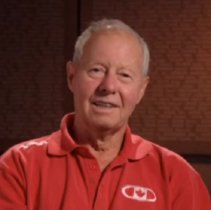
Doug Anakin Interview |
Interview Summary / Résumé d'entrevue |
Doug Anakin, Order of Sport recipient, inducted in 1964, born in Chatham, Ontario, talks about his athletic career. Doug explains how he played various sports growing up and wrestled competitively in university. Doug talks about meeting John Emery at university. Doug describes how, after university, he first moved to Banff and skied, how Franz Gabbel introduced him to mountaineering, and how he moved to Europe and spent time climbing in the Alps. Doug explains that he first became competitive in luge before meeting back up with the Emery brothers who invited him to join Canada's first ever bobsleigh team. Doug explains in detail how the 1964 Olympic gold-winning bobsleigh team formed and what adjustments they made to the sled, their push-start, and the grip of their shoes to increase their time. Doug talks about how the Italian team members Eugenio Monti and Sergio Zardini provided feedback and assisted with strategy. Doug talks about retiring from competition in 1966 and mentions the fatal accidents of German bobsledder Anton Pensberger in Cortina and Italian Sergio Zardini in Lake Placid. Doug explains that sport allows you to develop skills and adds excitement and meaning to your life. He talks about the importance of winning and losing, recalls a funny moment in Innsbruck, and shows his Gold Medal and a photograph of his students cheering him upon returning from the 1964 Olympic Winter Games. Entrevue avec Doug Anakin, 12 décembre 2006, temps de visionnement : 00:38:15. Doug Anakin, récipiendaire de l'Ordre du sport, a été intronisé en 1964 et est né à Chatham, en Ontario. Il parle de sa carrière sportive. Doug explique comment il a pratiqué divers sports pendant son enfance et a fait de la lutte de compétition à l'université. Doug parle de sa rencontre avec John Emery à l'université. Doug décrit qu'après l'université, il a d'abord déménagé à Banff et a fait du ski, que Franz Gabbel l'a initié à l'alpinisme, et qu'il a déménagé en Europe et a passé du temps à escalader les Alpes. Doug explique qu'il a d'abord fait de la compétition en luge avant de retrouver les frères Emery, qui l'ont invité à rejoindre la toute première équipe de bobsleigh du Canada. Doug décrit en détail comment l'équipe de bobsleigh ayant remporté la médaille d'or aux Jeux olympiques de 1964 s'est formée et comment ses membres ont modifié le design du traîneau, leur technique de poussée au départ et l'adhérence des semelles de leurs chaussures afin d'améliorer leur temps. Doug parle de la façon dont Eugenio Monti et Sergio Zardini, membres de l'équipe italienne, leur ont prodigué des conseils et les ont aidés avec la stratégie. Doug parle de sa retraite de la compétition en 1966 et mentionne les accidents mortels du pilote allemand de bobsleigh Anton Pensberger à Cortina et de l'Italien Sergio Zardini à Lake Placid. Doug explique que le sport vous permet de développer des compétences et ajoute de l'excitation et du sens à votre vie. Il parle de l'importance de gagner et de perdre, rappelle un moment amusant à Innsbruck et montre sa médaille d'or ainsi qu'une photographie de ses étudiants l'acclamant à son retour des Jeux olympiques d'hiver de 1964. |
Scope & Content |
Doug Anakin interview, 12 December 2006, total viewing time 00:38:15. 1/2: 00.39Growing up, what sports did you play? Grew up in Catham, Ontario, played shinny hockey, soccer in elementary school, "I remember scoring a goal and bringing pride to myself and my school". 01:08Did you have sports idols? We adored our fathers because they played soccer, adored the Chatham Maroons Hockey Team and the baseball team in the summer because we knew them, we also adored the guys in the NHL 02:17Was there ever a sport you thought you would take seriously enough as a career? I knew I wasn't tall enough to be a good basketball player but then a teacher came along with some wrestling and that became a sport that I really wanted to do, not as a career but for fun, and of course, I played soccer. Later I went to Queen's U and I took up skiing, with old wooden cross country and downhill skis and fell in love with it 02:50In Chatham there was a hill and we slid down the hill on little wooden sleds, frontwards, backwards, sideways, down on our skates. Our dads even had a bobsled race and I remember as a little boy standing around the campfire that night and celebrating the winners. 03:16And I remember those days of sliding and when we did it, when the firemen came and iced that hill we were overjoyed and we were thrilled to go fast. And the faster we went, the curvier we went, the better we liked it. I remembered that later on. 03:34Any idea what that it might lead to? No because I was born in 1930 and the very first bobsledding was in Lake Placid in 1932 but I had no idea as a kid we would ever get a chance to ride on bobsleds. But when they came along, the Emery brothers, my buddies from skiing and everything else, they said they had been over to Italy at the '56 Olympics and they got some bobsled rides and they were going to start working on a Canadian team, I became interested. 04:20How did you get involved in bobsled? As a young guy I admired athletes of course and one time we met Gordie Howe. In my own life I enjoyed outdoor activity, enjoyed the beauty of the wilderness and there are other aspects: you feel healthy through activity. So when I went to University I got onto the wrestling team for 4 years, if it wasn't for the wrestling I don't think I would have finished. I didn't know what career I was going to follow but finally I went out to Banff, driving buses. 05:18And I met Franz Gabbel, who won a Bronze medal in the '52 Olympics as Austria's top skier and he introduced me to mountain climbing. And of course I loved mountain climbing. And then one year we came out in the spring and did skiing on Mount Norquay on an avalanche slope and I loved this activity. 05:42I decided I would go to Europe and see all the culture and climb some mountains. I got coached by the mountaineers so I had the skills and pursued that. I came back to Canada, back and forth. Then one winter we skied in St. Anton, Austria and we met Eddie [Baron Eduard] von Falz-Fein, who was the treasurer of the World Luge Federation and Eddie persuaded us to go to Austria for the European Luge Championships. We had never heard of luge before. We went in the races and we went to Poland for a week for the World Championships and we loved it. We crashed and we did fairly well and when we came back to Canada I met the bobsledders in Lake Placid and they wanted me to join their team so we did. 06:40And off we went to in '63 to Innsbruck and I got some of them to come luging and I went bobsledding and that's how it all evolved. 06:58How did you meet the Emerys? What happened there - John Emery was on the boxing team at Queen's University and it was s small gymnasium and our wrestling team worked out right beside the boxers, so I could meet John and the other boxers and we could talk about sport. He went out to Mount Baker, Washington to ski and I was heading out to Banff to work with Brewsters, so I shared a ride with him and I got to know John very well. Later I met Vic, who went to Western. 07:44But he (Vic) and Monty Gordon, who was the other bobsled driver, had gone to Cortina in '56 and the British invited them to bobsled. So they loved it and scraped up some money and bought a bobsled. They went through many, many riders because they had many crashes in the beginning and a lot of people said that is enough of that. So by the time I came along they were pretty good drivers and didn't crash so much. So I was glad to get on the team. 08:17And from then on we developed a lot of camaraderie - skiing at Mount Washington, New Hampshire, and meeting up with Art and Andy Tommy. So after we did all these activities together it was easy to join up as the Canadian Bobsled Team. 09:15How did you get invited on the bobsleigh team? It all happened by chance some of it. I was teaching and went back to Europe, went to Garmisch-Partenkirchen and there was the Canadian bobsled team in the World Championships, so I watched them and then tried luge. By doing that we really got into the sliding sports and it was pretty easy the next year when the guys wanted us to join the bobsled team, so Fergus McDougall and I both became members of the team. [Doug then talks about the cost, paying their own expenses and doing skiing and bobsledding and having party time with the other teams.] There was lots of camaraderie and there for the real fun of it. 11:42As soon as you play a game and race there is the added dimension of pressure and satisfaction and the thrill and whatever happening, whether you win or lose, it has been as exciting event and you never forget a race. 12:02[talks about training and racing with Sergio Zardini and Eugenio Monti, on the Italian team, in Lake Placid in 1961 and the smooth ride, as well as doing 12 runs in one day.] 13:04[talks about the Olympics in Innsbruck, about one of the heats where the sled was going so fast in corner 13 that they ran out of ice and the sled bounced up about 3 feet and the team lunged to the side to keep it upright, otherwise they could have lost the opportunity for the Gold medal] 14:11Were you aware of the criticism about the Canadian team (interviewer refers to the "Intellectual Team")? Not until after the Olympics. At the Worlds we came in 11th. We had some runner damage and could have done better. We knew what we were doing and made adjustments to the sled such as moving the seats back so Vic was more relaxed and we didn't know it but putting the seats back put more weight on the runners and gave you added speed. 15:57In the first runs in Innsbruck the sled was sliding in the upper part and the team started "bobbing" but we accelerated on the runs and Vic had complete control on the corners. The centrifugal force pushed the runners into the ice. 16:44Is it true that the Italians took you under their wing? The Italian bobsled drivers were very friendly and Sergio Zardini and Eugenio Monti coached Vic, especially cornering and Vic listened. Other countries were more secretive of their strategies. 2/2 00.13Put everything in context about bobsled. First bobsled run: pushed as hard as you can so you can go as fast as you can knowing you are going to feel it on the way down. [talks about the speed and the corners and greying out from 3-4 G's] 1:30When we started I was shown how to rock the bobsled and push and run and I accomplished that quite well. In 1963 we modified the sled so the push bars could be put down beside the sled instead of standing up and that would cut down the wind resistance a little bit. 2:201964 - week before the Olympic Games decided who would be on each sled. Vic was the top driver and he got first pick. I was picked because I was small and agile and could fit between Vic [driver] and tall John. [mention of file cleaners on John's shoes hurting his legs] 3:03[discusses how they used a Canadian football-style push at the start and when they were timed it was a faster start] 3:52I was competing in luge but had crashed twice in qualifying [Doug competed in both luge and bobsleigh at the 1964 Olympics], very proud to do my own thing. [Doug was about to start his 3rd heat in luge when Vic told him they would miss the first training run in the bobsled event. Doug had already crashed and decided to go to the bobsleigh training. 4:21And we did that push and did a record time 1:02.99. We beat all the times with that start and that's all we needed because we knew because Vic's driving was good and the sled was sitting back. What an afternoon that was! 4:33We started to feel we could win if we kept it up and the next runs we kept it up. We kept beating everyone and they started copying our start during the week. 5:03How did you modify the sled? We moved the seats back. The handle for the driver was supported by elastics so if the handles were jerked out of his hands you could regrab the handles. [story about Vic losing the handles and Doug coaching him through the turns on the Cortina track] 5:55Gord Currie, the brakeman on the #2 sled, glued these file cleaners onto the bottom of our shoes. No other teams did that at first and then they saw that on the ice we had really good grip and weren't slipping and sliding. 6:30How much training did you have for the 1964 Olympic Games? [Doug talks about how none of the tracks were refrigerated then and how the European teams could train on their home track. He spent a month luging in Germany and then went to Cortina to train with the team and then to Innsbruck for the Olympic Winter Games.] 7:39How long did you continue to bobsled after 1964? After the 1964 race at Lake Placid, after the Olympic Winter Games, decided to retire at age 33. "There are lots of things in life that Doug Anakin hasn't done." [He talks about getting married and starting a family. He took much of 1965 off, did a little sledding in 1966 and raced in World Championships. He talks about the death of German bobsledder Anton Pensberger in Cortina and later of Zardini who was killed in competition in Lake Placid.] 10:32[He talks about luging, building tracks in Canada and a team, going to Sapporo in 1972 as a luge coach for Team Canada.] 12:22What is the most important life lesson you got from your life in sport? 12:57You are using your time that is set aside from work or study to do something where you can learn a skill, use the skill and then compete, it adds excitement and meaning to your life. 13:33Have you learned more from winning or losing? When you are losing you find out why you have lost so the next time you turn a corner or do an event you say "aha" and you get better, so your performance improves as you lose. 13:50When you win you put things together so you learn it is possible to achieve the best at that time. You may not be able to win again tomorrow. 14:04The other thing you learn from winning is that you have accomplished something because you have the skills, your energy level was high, you had the power to do it and the stamina and then you had the mental attitude that you were going to apply everything and make the right moves and decisions and come though with it. 14:35Do you recall a funny moment in your career? [talks about Innsbruck: lassoing a policeman in the process of trying to get a jacket down from a high wire] 16:54On being an Honoured Member: Canadians appreciate other Canadians going out and working hard, training, and giving up a lot of things for a sport and helping to make Canada shine. 17:07On participating in sport: I have done sport for health and fitness, for the social part, for the excitement of the sport, and to spend time in nature. Competition has another thrilling dimension. 19:04Shows Gold Medal from the 1964 Olympic Winter Games in Innsbruck. 19:44Shows framed photograph of his high school students (Doug was a high school physical education teacher) welcoming him home after winning the Gold Medal. |
Year Range from |
1963 |
Year Range to |
1965 |
People |
Anakin, Doug Emery, Victor Emery, John Kirby, Peter Monti, Eugenio Gordon, Monrty Currie, Gord |
Search Terms |
1964 Olympic Winter Games Innsbruck Douglas Anakin teamwork/team player Interview Doug Anakin Bobsleigh Olympic Winter Games Luge Gold Medal |