bil.png)
Archive Record
Images
Metadata
Object ID |
2022.9.4 B |
Object Name |
Video Recording |
Title |
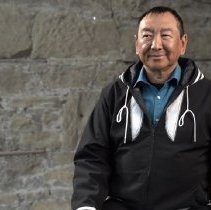
Hans Lennie Interview (about Edward Lennie) |
Interview Summary / Résumé d'entrevue |
Hans Lennie interview, 11 May 2022. Born digital MP4. Two videos with a total viewing time of 00:15:13. Edward Lennie, Order of Sport recipient, inducted in 2022, born in Imaryuk/Husky Lakes, Northwest Territories, is represented in this interview by his son, Hans Lennie. Hans is asked about the value of sport and replies by talking about the value it provides to youth. The interviewer describes the Order of Sport Award and asks Hans how it feels to have his father, Edward, recognized for his contributions to Traditional Arctic Games. Hans describes his father's passion for the Northern Games and Arctic Winter Games. He talks about how the Games are essential for youth and how Edward always encouraged youth to try. Hans briefly talks about Edward's early life and how, as part Gwich'in and Inuvialuit, he was equipped to navigate multiple communities and was a welcoming, friendly person. The role of sport in Reconciliation is discussed, as well as the strong community support that enabled the success of the Games. Hans thanks the many people who assisted his father and the volunteers. Entrevue avec Hans Lennie, 11 mai 2022. MP4 d'origine numérique. Deux vidéos d'une durée totale de visionnement de : 00:15:13. Edward Lennie, récipiendaire de l'Ordre du sport, a été intronisé en 2022 et est né à Imaryuk - Husky Lakes, dans les Territoires du Nord-Ouest. Il est représenté dans cette entrevue par son fils, Hans Lennie. On lui demande de parler de la valeur du sport et il répond en parlant des avantages que le sport offre aux jeunes. La personne qui dirige l'entrevue décrit l'Ordre du sport et demande à Hans de parler de ce qu'il éprouve en voyant son père reconnu pour sa contribution aux Jeux traditionnels de l'Arctique. Hans décrit la passion de son père pour les Jeux du Nord et les Jeux d'hiver de l'Arctique. Il décrit comment les Jeux sont essentiels pour les jeunes et comment Edward encourageait toujours les jeunes à essayer. Il parle brièvement de la jeunesse d'Edward et de comment, en tant que Gwich'in et Inuvialuit, il était en mesure d'évoluer avec aisance dans de multiples communautés et comment il était une personne accueillante et sympathique. Il discute du rôle du sport dans la réconciliation, ainsi que de l'appui communautaire solide ayant permis le succès des Jeux. Hans remercie les nombreuses personnes qui ont aidé son père ainsi que les bénévoles. |
Scope & Content |
Hans Lennie interview, 11 May 2022. Hans is interviewed about his father, Edward Lennie, a 2022 inductee into Canada's Sports Hall of Fame. Born digital MP4. Two videos with a total viewing time of 00:15:13. Transcription (edited): Misty:This is a very broad question, but what do you believe is the value of sport? Hans Lennie:The value of sport I believe is ensuring that it's passed on to our youth, just to continue the legacy for the future. These games prepare you for life, real life events. It's strength, the agility, and endurance. Lot of these games are based on individual performances. And the way my father did it, he pushed and always tried to beat your personal best. That was his philosophy behind it. Misty:Good? Speaker 2:Yep. Misty:Okay. So, Canada's Sports Hall of Fame created the Order of Sport Award in 2019, and it really symbolizes not only excellence in sport, but those who go beyond sport to impact their community, and to ultimately make this country a better place. And so, your father is named as part of this class. How does that feel to have him recognized, and in October, the Order of Sport Award on his behalf? Hans Lennie:Well, it's a complete honor that my father's dream has come true. The games are now recognized internationally. And it all started in our kitchen room floor. That's where it all started. And it's now part of the Arctic Winter Games, the Canada Winter Games. And it was also part of a demonstration sport in the Vancouver Olympics. That in itself is, speaks for itself. Misty:As a follow-up to that, really, having your father named as part of the class, it's really, our hope as Canada's Sports Hall of Fame, is that it amplifies this incredible story that your father has. What do you think is the importance of having youth, indigenous or non-indigenous, hearing about his story? What do you think the importance of that is? Hans Lennie:Well, the importance is that these games, they build character and self-esteem. The youth, one of the biggest messages that my dad promoted was, you can never say I can't, you have to at least try. He pushed the youth to try any part of the game. The biggest thing is, you have to try. You cannot say you can't. Misty:That's a wonderful legacy in of itself. Speaker 2:That's great. Misty:Do you think sport in of itself and your father's role in sport helped supported him in the face of adversities? Do you think sport played a role in how he faced different challenges? Hans Lennie:Well, that's a thing for the Northern people, we've always had to face difficulties, adversities, as you put it. We had to deal with the cold. We had to deal with climate change and everything else like that. It's instilled into us. But these games brought that out and actually got you ready for those adversities, the strength, the endurance part of it. Misty:Yeah [inaudible 00:05:25] Hans Lennie:It's so recent, the climate change talk, but anyway. Misty:I think just the thread of resilience, right? Hans Lennie:Yeah. Misty:As the Father of the Northern Games, what would you say is your father's legacy? That in of itself is a pretty substantial... Hans Lennie:Yes, the Father of the Northern Games, he was always dubbed that. And he was such an outgoing person, and just seeing everyone... He comes from two different cultures, and his mother was a Gwich'in and his father was an Inuvialuit, had made it so much easier for him in our communities to communicate together, to go out and meet everyone. He knew them because of this history. And it was just so much easy for him to just meet people, greet people, and making them feel welcomed. That was his biggest trait. He made them feel welcomed. Misty:And when you think of your father, what do you think of? Hans Lennie:Resilience. He went to grade three, that's his only education. He owned his own business. And that alone is an accomplish just by itself. He sat on many boards. He couldn't write very good, but he could speak really good. So, he always had someone recording his message that he tried to get across. So, the resilience of that, and growing up without parents, that itself is a big accomplishment. Misty:Wow. And then, I think that covers so much. This is, again, a broader question, but what do you feel the role of sport is on the path to reconciliation for Canada? Hans Lennie:Well, it's an avenue to help reconcile. The way the Northern Games was designed, and the way that my father had put it, you always realized that there was someone else better than you. And that's not something bad to think about. What he pushed was, if there's someone better than you in a sport, and they beat you, you walk over there and shake his hand. That means there's someone else better than you. That's the style of sport that he pushed. And through everything else, with residential school and everything else like that, it was an avenue to let some of that out. You try your best. You try your hardest. That's what he's seen. He's seen the young athletes. He's seen the potential within them already, before they even knew it. And it didn't matter who you were, what color you were. He walked over to you. He'd give you advice how to improve. It might be improve in that sport, but how to improve in life. Misty:So your father was instrumental in the community, and giving back and building up the community. And you speak of his interaction with people, no matter their background, and really believing in the potential of people he met and young athletes. He did so much for his community, but what members of the community supported him, in making that impact? What role do you think his community around him had? Hans Lennie:The role that the community and the people around, that helped out the most. And there's always key people that continue to support. Some key role people, people like Nellie Cournoyea, Billy Day, Doug Dietrich, and Kenneth Peeloolook was an elder that he had relied upon a lot. And I just want to mention also the original boys that grew up around our home, that started on our kitchen floor. They're the ones that came in and not only did the sport, but were around to help, be part of the family. And I just want to mention their names if that's okay. The original group was Mickey Gordon, Glen Tingmiak, Abel Tingmiak, Tommy Chicksi, Fred Dick, Pat Tingmiak, William Day, Roy Ipana, Tommy Smith, Gerry Kisoun, Charlie Kasook, Angus Alunik, Charles Komiak, and Steve Cockney. They're the people that were around at our house, at our kitchen floor, competing with each other. And also there for my mother's food. And I just want to explain also, too, part of the games... The games were a big part of it, but also included in the games was the good woman contest. The dancing, my father was a foremost front and center of the old-time square dancing. He was there, it was lively. And also a big part of that is the traditional food, is part of the games also. But one of the biggest factors of the games is the volunteers. They're the ones who ensured that it continued and was there for the future. I just want to say thank you to all the volunteers and all the future volunteers coming up. Thank you for that. |
Date |
2022/05/11 |
People |
Lennie, Hans Lennie, Edward |
Search Terms |
Hans Lennie Edward Lennie Interview Traditional Arctic Sports Arctic Winter Games Northern Games Indigenous Inuvialuit |