bil.png)
Archive Record
Images
Metadata
Object ID |
2015.5.22 |
Object Name |
Video Recording |
Title |
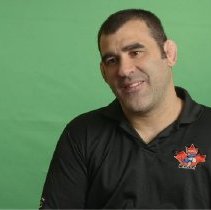
Nicolas Gill Interview |
Interview Summary / Résumé d'entrevue |
Nicolas Gill, Order of Sport recipient, inducted in 2015, born in Montreal, Québec, describes how he became interested in competitive judo as a youth. Nicolas talks about how he needed to travel to Japan and Europe to train properly. He emphasizes that financially supporting his dreams was challenging for him and his parents. Nicolas mentions how he began training under the elite Sensei Hiroshi Nakamura at the Club de judo Shidokan in 1985. Nicolas describes his best memory as when he competed in 2000 at the Olympic Games in Sydney, fought "the best guy in the world," and won Silver. When describing what he is most proud of, Nicolas talks about how he had been ranked in the top ten in the world throughout his career, in different weight classes, and over a few generations of judo players. He explains how the sport has evolved since the dissolution of the USSR. Nicolas attributes his understanding of the former and current fighting styles to being a better coach. Nicolas recalls what it felt like to be the flag-bearer at the Opening Ceremonies of the 2004 Olympic Games in Athens and talks about why he started the Nicolas Gill Foundation. He also talks about coaching Antoine Valois-Fortier in the lead-up to the 2016 Olympic Games in Rio de Janeiro. Nicolas describes the values that are important to him, and his message to youth is to "find your passion…and enjoy the ride." Entrevue avec Nicolas Gill, juin 2015. MP4 d'origine numérique, temps de visionnement : 00:34:38. Nicolas Gill, récipiendaire de l'Ordre du sport, a été intronisé en 2015 et est né à Montréal, au Québec. Il décrit comment il a commencé à s'intéresser au judo compétitif lorsqu'il était jeune. Nicolas parle de la nécessité de voyager au Japon et en Europe pour s'entraîner de façon adéquate. Il souligne qu'il était difficile pour lui et ses parents d'assurer l'appui financier de ses rêves. Nicolas raconte comment il a commencé à s'entraîner avec le sensei d'élite Hiroshi Nakamura au Club de judo Shidokan en 1985. Nicolas décrit ses meilleurs souvenirs, soit lorsqu'il a pris part aux Jeux olympiques de 2000 à Sydney, s'est battu contre " le meilleur gars au monde " et a remporté la médaille d'argent. Lorsqu'il décrit ce dont il est le plus fier, Nicolas parle du fait d'avoir figuré parmi les dix meilleurs judokas au monde tout au long de sa carrière, dans différentes catégories de poids et sur plusieurs générations de judokas. Il explique comment le sport a évolué depuis la dissolution de l'URSS. Nicolas attribue sa compréhension des styles de combat anciens et actuels au fait d'être un meilleur entraîneur. Nicolas décrit comment il s'est senti en tant que porte-drapeau lors de la cérémonie d'ouverture des Jeux olympiques de 2004 à Athènes et parle de la raison pour laquelle il a créé la Fondation Nicolas Gill. Il parle également de l'entraînement d'Antoine Valois-Fortier en vue des Jeux olympiques de 2016 à Rio de Janeiro. Nicolas décrit les valeurs qui lui sont importantes, et son message à l'intention des jeunes est de " trouver sa passion... et profiter de l'aventure. " |
Scope & Content |
Nicolas Gill interview, June 2015. Born digital MP4, viewing time 00:34:38. Transcript: Interviewer (00:15): And my first question for you, Nicolas, is take me back to the beginning when you were young, when did you first realize you had a passion for judo? Nicolas Gill (00:29): My brother started a bit before I started Judo and...Okay, when he was attending his class, coming back home, he was showing me some stuff. It really didn't get me interested at that time, until one of his first competition, my mom brought me to watch it. And as soon as I'd seen the competition, I wanted to start. And at that time, my desire was not to do judo, it was to compete and win. So this is really when, as soon as I saw the competition setting in the... That's when I told my mom I want to do this. And I started right after and discovered quickly that if you weren't... I did my first competition, I think it was two weeks after my first class and honestly I was not good. So after two weeks of training, I discovered quickly that you needed to work hard to succeed, and I really started then my... Started right away and being very competitive and really having the desire to train and compete. Interviewer (01:45): Were you inspired by anyone in particular? I guess, was it your brother? Nicolas Gill (01:53): I don't think so. I think it was... Okay, I started at six years old. At six years old you have, I think, very simple way of thinking. And one of my clear memory of my first class, when we bow in the beginning of the class, you go by rank and it was my first class, I was last in line and I have this clear memory, I look in front who is the head of the class and I say, okay, this is the guy that I have to take down. So for me it was always about being the best and beating the best. And of course I started with the best of my class and then later it became the best of the town and best of province, best of the country. And when I understood what Olympics World Championship was all about, my quest was to be a world champion, an Olympic champion. And it always been there since the beginning and really it was a pure internal desire and really not followed by... Didn't feel the need to follow anyone. Interviewer (03:10): That is a good story. Everybody has challenges in their career, what were some of your biggest challenges? Was it just training or competition or what was your challenge? Nicolas Gill (03:25): I had, I think a quite smooth ride. Obviously the biggest challenge to be a world class judo player in Canada. Canada is a small judo country. I think, there's a little up and downs injuries and so on, but I think that the biggest challenge to succeed from Canada is to be... The need to travel the world and to go train in a very remote place and spend a lot of time away and so on. I think at that time, this sports system was not so well developed. Funding was not what it is now. And, definitely the key part for me in that challenge was that, I had the support of my parents, and without them, it would've been impossible to succeed because there was no other way to fund that. (04:28): Especially the years prior to Barcelona Olympics, my father had to fund most of my competition and training, and a lot of those training camp had to be done by myself in Japan or Europe. So for me, I had the luck to have the parents that were willing to support me. And I enjoyed doing it. So really the support part was the key ingredient to the success. Interviewer (04:59): Now it says you won many tournaments including two Olympic medals and medals from Panam, Commonwealth, World Championships, National Championships. That's quite a resume. Is there one that stands out to you, if you can remember? Nicolas Gill (05:16): Every new step you take is a great accomplishment at the time. I have great memory of when I won the Montreal games when I was a little young boy, for me was the biggest thing it could be. At the time, I think I can easily compare the way I felt as I won a medal in Barcelona, at the Olympics. Of course, when you're eight years old and it's a different perspective than when you're 20 years old and so on. So with time and you look at everything now, obviously the two Olympic medal are the biggest accomplishment that I've done. (06:00): The first one was, to me it was great, because it was the first one. It was not expected. I was the young kid that was coming up, and maybe one day he would succeed in Barcelona, was that day. Eight years later, it was a bit the opposite. I was up weight class, I had a few injuries, few surgeries, and it was kind of my last chance to... My feeling was a bit my last chance to accomplish that and redo what I did eight years prior. So it was also another great feeling to be able to repeat and to be so close to... Obviously my goal was always to be a gold medalist. It was never to be second. So to have a chance to face at the time the Japanese, that was by far the best guy in the world, in the biggest setting, to me it was an incredible opportunity And one of my best memory. Interviewer (07:11): I think John Pierre told us about Barcelona story, how it was no medals for Canada and yours was the first one, it was huge, he said at the time. Nicolas Gill (07:20): Yeah, definitely. For me, I didn't realize anything of this and I just worry about my own issue, and I learned after that I won the medal that it was the first one. And there was very few journalists expecting it and very few attending the events. So I did my medal ceremony. I did two interviews and to me I said, oh, that's kind of cool. And I went to my doping control and I thought everything was done now, I could celebrate and have fun. And I got out of the doping control and there was a crowd of journalists waiting for me. So it was a big shock and it's really when I realized that... Well, I learned then it was the first medal and I realize what it meant. And then I discovered that journalists in Canada were starting to doubt that that first medal would ever come and so on. So it's really then I understood what I did and the effect it will have on the rest of my career and life. Interviewer (08:42): Yeah, big responsibility [inaudible 00:08:45] when you found that out. Nicolas Gill (08:45): Yeah, exactly. It comes with, like you said, certain responsibility. And then the rest of your way you're carrying that medal and expectation that comes with it and people are suddenly, you're being judged for every performance and so on, and they're expecting you to repeat all the time. Overall, it went fairly well and for me it was not such a big deal because my expectation were probably even higher than the expectation that people had of me. So I think the problems occur when your expectation are a bit lower than what people are expecting from you. In my case, it was a transition, but it was an easy transition to go through. Interviewer (09:37): Interesting. What are you most proud of from your judo career? Nicolas Gill (09:46): I think the whole, to be able to have been at the top. Roughly, I've been in top 10 in the world for my whole career. To have done it over that length of time, to have done it in few different weight classes, over a few generation of judo players. I think in the judo history, I think there's a clear evolution between when the Berlin Wall fail and the USSR split up, the judo scene completely changed. USSR, and then the whole US Soviet states are all very strong judo nation. Judo is one of their main sport in Georgia, Uzbekistan, Kazakhstan, Ukraine, et cetera, et cetera. (10:43): So to have seen both era of Judo, I would say and to be successful in both, I think for me that's quite an accomplishment. And I can easily say that the 1992 medal performance wouldn't probably not have been good enough, to medal in 2000. And to be able to see two different era of Judo and compete in both and succeed in both to me is probably what I can... And I think that today when I coach and I talk to young kids competing, I think it makes me a much better coach to be able to understand that whole judo history. Interviewer (11:38): Yeah, I bet that would be very helpful. Okay. Pardon my pronunciation, but you're known for a lightning fast Uchi mata. Is that how you say it? Nicolas Gill (11:47): Good pronunciation. Interviewer (11:51): Uchi mata and near unstoppable Osotogari. Osotogari. That's brutal. How did you master such throws? Nicolas Gill (12:05): Well, just through training, I think. Well, you need the proper teaching to start with. In 1985, I changed club and I went to Hiroshi Nakamura, Shidokan club. That was the first step towards becoming a real international judo player. I needed to go work with the best coach in the country, train with the best in the country. I did at a very young age, and at that time, most people were telling me not to do that. Like most thing I've done in my life, most people told me, don't do it. But to me, this was the only solution to achieve my goals. So start with proper coaching, proper teaching, then proper training, and then desire to succeed. And I think that's it. It's fairly simple, but you need to be able to invest the time and the effort. Interviewer (13:25): Well answered. Oh, this is an interesting one. You were chosen to be the flag-bearer at the opening ceremonies of the 2004 Summer Olympics games in Athens. How'd you feel when you walked out in the stadium and you're representing Canada? Nicolas Gill (13:47): I think that was a very special moment. I think to me, this sum up my career well. I would say one thing that went through my mind is don't trip. Once that... Because I almost did. And for me, this was like cherry on the cake, I would say, to a great career. And it was a moment where I really had flashback of all my career and my past Olympic performance and the world performance, and I could not have asked for a better way to complete my Olympic career. Interviewer (14:40): Was that the year, because John Pierre told us that it was the first time a judo player had been picked to carry a flag. Is that correct? Nicolas Gill (14:50): I think Doug Rogers did it in 1968, 72, at 1972 I think. I think you would need to check on Wikipedia, but. Well, I mean this is in the world of judo we're not used to be recognized to that level, and fellow judo player to be recognized to that. So I think for the judo community, to be put in front of the whole Olympic team and to be... I think, okay, for me it was a great recognition of my career. But for the sport, I think it was to be in the center stage like this, it was a really rare occasion. And I think for the judo community, I think everybody was really pleased to be... I think the personal recognition went past that and the judo community felt that this belonged a bit to them also. Interviewer (16:00): Yeah, I guess John Pierre told us a few other nations had judo, flag-bearers, and he said it was amazing for the sports. Nicolas Gill (16:07): Yeah. Interviewer (16:08): You guys knew everybody and... Nicolas Gill (16:09): Yeah, I think the Athens Olympics, something like 11 judo player were flag bearer and about seven were in my actual weight division. So it was kind of a very interesting thing to see just as for a judo fan to watch the opening ceremony come in and see all those big judo name to be in front of their countries, I think was for Judo fanatic, I think it was probably quite a good memory like John Pierre mentioned. Interviewer (16:52): Yeah. Can you tell us about your foundation? Nicolas Gill Foundation? Nicolas Gill (17:00): Yes. Interviewer (17:01): Why did you start it? Nicolas Gill (17:02): Well, I think the goal is to help young judo player that, like I mentioned before, I was fortunate enough that my father was able to support me and that he wanted to support me, but not all the kids have this chance. I think my goal is that financial restriction is not a limitation to kids achieving their goal. So if I can contribute in a small fashion, then I think this is the least I can do. I think it comes with that responsibility you mentioned before. I think for me this is, I just hope that no young kids are limited by their financial because of... I think everybody should have the same opportunity that I had to go all the way to where they want to be, and hopefully I can help. Interviewer (18:12): Yeah. That would've been expensive for your father to send you to Europe to train. That would've cost a lot of [inaudible 00:18:19] Nicolas Gill (18:20): Yeah. I think the Barcelona Olympic, I would say two years before were very expensive for my parents. They had to obviously sacrifice more than me because I was just doing what I wanted. They had to sacrifice. It's always a question that I'm being asked, what sacrifice you had to do to do this? For me, I had no sacrifice to do, sacrifice [inaudible 00:18:48] not to do it or not being able to do it. My parents had to sacrifice holidays and maybe bigger car. I don't know what they would've liked to do with the money they invested in my career, but for them, okay, maybe it was their first choice too. But I think for me it was, they had to do the hardest part of it than me that just did what I love. Interviewer (19:18): I bet they were happy to do it. Nicolas Gill (19:20): Yeah, I think so. But my father always told me, this is okay. I'm willing to help you, but you need to do what you have to do and work hard. And I'm not paying you to go on holidays. I'm paying you to go train and work hard and hopefully succeed. Interviewer (19:46): Yeah. You've been a national head coach for judo since 2009. I guess it's got here, Antoine, was a bronze medalist at the 2012 Summer Olympic Games. Is he your most successful protege? Nicolas Gill (20:09): Yeah. Interviewer (20:10): And how does it feel when you're a coach and you mentor someone to win? Nicolas Gill (20:18): I think it was, for Antoine to win a medal in London was a great achievement for him. For myself, it was, I think a great pleasure to be part of that. I think his road to London started a few years back, and he came back from a serious back injury that put him out for a full year. And so his journey started very small. He had to go back to more regional competition, and this medal is starting to be built by just finding small tournament outside of Toronto, to slowly get back into form and before competing a national championship and international event. And at the time, he had the goal to qualify, but he was still just fighting local event. (21:22): So it was a great journey, and he's a kid that works really hard and that's really dedicated. And so he deserve all the success he had, and just to be able to help him and to be part of that journey was a pleasure for me. And he had just won a second world medal two weeks ago in Kazakhstan, and he is slowly getting ready for Rio, and hopefully he will repeat. I always said, it will be very difficult to have somebody replicate what I did, but he's well on his way to do it, and for me to be part of this, it's another incredible experience. Interviewer (22:15): Probably feels pretty good. What values were most important to you in your journey and why? Nicolas Gill (22:26): I think you have to be humble. You have to really be able to really know your strength, your weakness. You need to recognize the strength and weakness of others. Now I see it from a coach perspective, I think this is one of the most important thing to succeed. You need to know who you are, you need to look at yourself in the mirror and really see the exact picture. So this is, I think, the foundation of hardwork and motivation and you need to be able to... It's all the things that I think I discover quickly. Success doesn't come by luck or... It comes through a process and it's start with very simple value, like humility, hard work, and dedication. Interviewer (23:38): What lessons or message would you like to share that you think would help youth in their life, and regardless of participation in judo, what would you share? Nicolas Gill (23:53): I see it now with athletes that come by or retire and so on, it's easy to succeed and work hard when you're doing something you like, when you have a passion for whatever it is, it's easy to be committed, but it's difficult to replace. [inaudible 00:24:21] Okay, your life as an athlete is short. You might be difficult to find the same passion towards certain things, another thing. So I think it's important for a kid to find that passion towards, whatever it's a sport, art, whatever they like, because this is really... Their journey becomes so easy after, and you're not thinking of sacrificing anything or missing anything. I think the people that are missing something is people that go through their life without full passion towards their choice of work or of sport or art or... So I think this... If I've a message is to find your passion and go dive head first in it and enjoy the ride. Interviewer (25:17): Last question, Nicolas. What does it mean to you to be inducted into Canada's Sport Hall of Fame? Nicolas Gill (25:23): First thought is, I'm old. Really, it brings back good memories, brings back opportunity to share those good memories with people that you enjoy. And in our busy life, we too often don't have... Take the time for that. For me, it was my goal to be a successful judo player, but along the way it was... It was always important that I enjoy the process and it's the same thing here. It just give me an opportunity to go back and rethink, re-live this process and the people I went through it. So just for that, it was... I'm glad that the hall of fame bring me back a bit my past life. |
Date |
2015/ / |
Year Range from |
1990 |
People |
Gill, Nicolas |
Search Terms |
Nicolas Gill interview judo athlete 1992 Barcelona Olympic Games 1996 Athens Olympic Games World Judo Championships Pan American Games 2000 Sydney Olympic Games Flag Bearer Judo Canada La foundation Nicolas Gill |