bil.png)
Archive Record
Images
Metadata
Object ID |
2013.55.137 B |
Object Name |
Video Recording |
Title |
Anne Ottenbrite Interview |
Scope & Content |
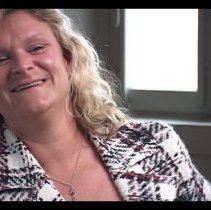
Anne Ottenbrite interview, 28 September 2006. Digitized MP4 from Sony 40 Advanced ME DVCAM. Two videos with a total viewing time of 00:51:07. 1 of 2; 01:12Introduction to Hall 02:16Childhood: had backyard pool; had a natural whip kick which helps in the breaststroke, at age 12 motivated by the 1976 Olympics and was overwhelmed by Nadia Comaneci; decided she had to find a sport where she could win a Gold medal, tried a lot of different sports and found water 03:32Always liked being in the water, tried synchronized swimming and diving, anything water related; as soon as started competitive swimming she thrived, fell madly in love with it right away 04:04Training regime: by 13 working in full complement of full practices, twice a day; talks about the regime 05:07On doing different strokes: focused on being a well-rounded athlete; as a coach now she doesn't limit her athletes t one thing; the whip kick and the breaststroke were her strengths, did compete in everything 05:43Describe the whip kick and the breaststroke: at that time it was a low breaststroke swum across the world, she had a very strong whip kick that caused her body to come up high out of the water, today it is called a wave stroke, at that time it was confusing to the officials and she was disqualified a few times; after she retired the rules changed to allow the kick 07:03Was it natural: it was, describes the problems with the kick and with her feet breaking the surface of the water; she had to change the kick and it was difficult to do 08:48Was it psychologically distracting to change the kick: distracting because when she swam races she was very focused on the task at hand; talks about how she broke the race down into lengths and splits; difficult to follow this if she had to focus on her feet; she was supported by a staff who encouraged her and helped her to refocus 10:09On splits and stokes: talks about the strategy, increase the turnover rate by the mid-50 point, she was a strong finisher in her races 11:29On being competitive: the turning point was making the Canada Games on the Ontario team, she was blown away by the production, turning point where she decided "I'm going to go to the Olympics. I'm going to make this happen"; in 1984 she was put on the Olympic team despite having a dislocated knee, she had to reassess and readjust her training and motivation; she had a very strategic 5-year plan, had a plan where every year where she wanted to see herself, where time-wise she wanted to be and where she wanted to place in the world to be on the podium; when she got to LA she was unsure of where she would be because of her injury, when she made the finals she knew she would win, "if I stayed focused on the task at hand, I knew I would win" 14:00First big win in 1983 at the Pan-Americans: at the time she was the best in the world, confident she could win, focus on her time and breaking the Canadian record, her plan for that year was to have a time at 30 or 31 so the next year she could break the world record 15:02On being a teenager and competing - did you miss out: maybe a little; had a group of friends she would socialize with outside of the pool; felt her life was so much fuller, she got to travel and do things; loved being on the Canadian team and representing Canada and travelling with the team 16:26LA 1984: won Gold in the 200, Silver in the 100; Bronze in the 4 x 100m medley relay, swam the breaststroke lap 16:49On swimming in the relay: that year it was a team effort, she had won her individual medals by the time of the relay, the team was really focussed, one of the most satisfying medals because the other girls really rallied and dug down and were able to find stuff in themselves that they had not been able to find in their individual events, really proud of them 18:05How do you race your opponents: talks about peripheral vision and how you develop it; you don't want to be focussing on the other swimmers because then you've lost your focus on the task at hand; important for young athletes to stay focussed on your task and what you need to be doing, you should be able to know what they are doing and what the outcome will be; talks about different race strategies 20:15How do you know you've got a great race going: had a good internal race clock developed through repetition in practises that simulated races, talks about training paces and knowing the time it took so when racing she instinctively knew the time 21:47Strategy: her strength was the back end of the race, did her own race so she knew by the 3rd 50 she could pick it up, strategy to come from behind and finish, confident with that 22:17There are no options in the breaststroke for long distances, did swim the 400 IM, could be have a great miler in the breaststroke if they had had it 22:47On being able to twist her feet and elbows: calls them party tricks; she is double jointed so when she dislocated her knee she did not blow out the ACL, she was injured but was going to recover; can't really say if being double jointed benefitted her; her shoulders would go out when she dove in and she had to put them back in, trained for that 25:01Competing on a level field: tells story about 1982 World Championships and seeing the East German women's bodies looking like men's because of the steroids; really taken aback; at that time steroids was only with the East Germans; testing was random, not like it is today; need to monitor training; back then so raw they didn't really know what they were testing for 28:14Today it's a completely different environment with supplements, etc. that can enhance your training and recovery systems, a fine line now; her coach told her "Nobody is ever unbeatable", believed that 29:32Last race: after the Olympics her focus changed, went to USC on a scholarship; her motivation was not the same, the passion and excitement weren't there; stayed there for 2 years and back and finished her degree at Sir Wilfred Laurier University; she had retired by that point, had retired mentally at 18 31:36What she like about swimming: just a place she belonged in; loved the sound, the feel of the water, of her body moving through the water, most comforting place she knows 32:22On coaching: while at Sir Wilfred Laurier had an opportunity to coach, before that had never considered coaching was an option; in the transition from athlete to the real world she was fearful she would not fin that passion again because to find that kind of intensity even once in your life is a gift; when she started coaching she fell in love with doing this task; now can't get off the pool deck; "the part I enjoy the most when I'm coaching is when the light bulbs go off in the athletes' minds and they can see the process and understand goal setting and empowerment and how those skills can lead to motivation and become empowered athletes. And when that that happens it is probably one of the biggest paybacks I could get"; a skill that can carry them through life 35:29On the transition: "When I was done, I was just done"; a mental thing; problem was that she was someone who was goal oriented, now in a process when not doing it anymore, what do I replace this goal setting with, difficult for her; if you don't have something to slip into to keep the goal setting going, this process can end in a very negative environment; now have programmes to help with transition 37:03Satisfaction as a coach: when you see kids who want to share that moment with you it is satisfying 37:40Life lesson: goal setting, understanding that everything is a step, a goal, and every time you take a step is a goal achieved, no matter how small, is still stepping you towards that; as an athlete able to carry forward how goals affect your motivation and how you can control your goal setting and make sure you are in control of your motivation 38:53On sport culture: culture varies from sport to sport but there is a pride being an athlete on a Canadian team, there is nothing better, we are the best people in the world 39:41On representing Canada: there are different rivalries and different focuses in different meets; the national team you are one, one unit, most supportive team, seeing the flag and hearing the anthem what was what it was all about, always strive for it 2 of 2; 00:09If you placed 4th or 5th would you have kept on swimming: always wanted to go to an Olympics and win a Gold medal; once that was achieved I was done; when she injured her knee she was willing not go and continue for another 4 years, but then when I won it was done 02:35Fortunate in her career, see so many other athletes who are haunted for the rest of their lives by a mistake; her belief system is "every time you have an opportunity to race you do your best"; has respect for the competition |
Date |
2006/09/28 |
People |
Ottenbrite, Anne |
Search Terms |
Interview Anne Ottenbrite swimming aquatics women in sport 1984 Olympic Games Los Angles 1983 Pan American Games Caracas World Championships Coach |