bil.png)
Archive Record
Images
Metadata
Object ID |
2015.5.16 |
Object Name |
Video Recording |
Title |
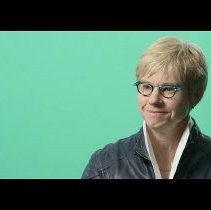
Lori-Ann Muenzer Interview |
Interview Summary / Résumé d'entrevue |
Lori-Ann Muenzer, Order of Sport recipient, inducted in 2015, born in Toronto, Ontario, talks about bicycling, the 2000 and 2004 Olympic Games in Sydney and Athens, and her values. Lori-Ann recalls the joy she felt in cycling as a youth, and explains how her passion and joy never diminished. Lori-Ann describes how challenging it was to train full-time while also working full-time, breaks down the cost of a professional bicycle, and how important it was to take care of the silk tires. Lori-Ann describes her ambition to return to the Olympic Games after her first appearance in 2000 and explains that age was not a factor for her during the 2004 Olympic Games, despite being the oldest athlete competing in her events. Lori-Ann describes the importance of the University of Alberta Academic Medal she wore while competing, how it was a talisman and remembrance of a good friend, Brenda, and how she honoured Brenda on the podium. She also describes what went through her mind while on the podium. Lori-Ann talks about her October 1999 cycling accident and her commitment to appearing at the Olympic Games less than ten months afterwards. She explains how her belief in fair play and sportsmanship trumps winning a Gold Medal, which she sacrificed at the 2002 Commonwealth Games, and how she values safety, integrity, and respect. Entrevue avec Lori-Ann Muenzer, 26 juin 2015. MP4 d'origine numérique, temps de visionnement : 00:18:25. Lori-Ann Muenzer, récipiendaire de l'Ordre du sport, a été intronisée en 2015 et est née à Toronto, en Ontario. Elle parle de parle de cyclisme, des Jeux olympiques de 2000 et 2004 à Sydney et Athènes et de ses valeurs. Lori-Ann se remémore la joie qu'elle ressentait en faisant du vélo dans sa jeunesse et explique comment sa passion et sa joie n'ont jamais diminué. Lori-Ann décrit la difficulté de s'entraîner à plein-temps tout en travaillant à plein-temps, elle détaille le coût d'un vélo professionnel et parle de l'importance de prendre soin des pneus en soie. Lori-Ann décrit l'ambition qu'elle avait de retourner aux Jeux olympiques après sa première apparition en 2000 et explique que l'âge n'était pas un facteur pour elle lors des Jeux olympiques de 2004, malgré le fait qu'elle était l'athlète la plus âgée des épreuves auxquelles elle participait. Lori-Ann décrit l'importance de la Médaille académique de l'Université de l'Alberta qu'elle portait en compétition, comment c'était un talisman et un souvenir d'une bonne amie, Brenda, et comment elle a honoré Brenda sur le podium. Elle décrit également à quoi elle pensait sur le podium. Lori-Ann parle de son accident de vélo survenu en octobre 1999 et de sa détermination à participer aux Jeux olympiques moins de dix mois plus tard. Elle explique que pour elle, l'équité et l'esprit sportif l'emportent sur l'impératif de remporter une médaille d'or, qu'elle a sacrifiée aux Jeux du Commonwealth de 2002. Elle ajoute comment elle valorise la sécurité, l'intégrité et le respect. |
Scope & Content |
Lori-Ann Muenzer interview, 26 June 2015. Born digital MP4, viewing time 00:18:25. 0:28Lori-Ann Muenzer. Growing up, her grandpa put together bicycles, so there were always bicycles for her and her sister to ride. Were always riding them. Even in late teens and early twenties. Was freedom of where you could go and exploring the city. Was something to do. 1:17Always had bicycles in stock. Never stopped. 1:51Biggest challenge was working full-time and training full-time. Balancing life, being normal, getting 40 hour work week and training before and after work, always on the weekend. Funding was a challenge, affording equipment, training events, getting out to races that weren't funded. 2:30Bike frame was worth $6 000, wheels were $6 000, handle bars were made of steel, were about $250, tires made of pure silk, came from France, worth $200USD each. Only had two pairs, one glued onto tire, only had 40km worth of distance on it. When got off track carried bike, cleaned tires to make sure no wood from track. Needed chain, gears, peddles. 3:28Frame has to be right size. Wheels, handlebars, and chains are all standard. Cars pump tires up to 32-34 psi. For training pump tires up to 100-120psi. Race tires because they were made of silk could be pumped up to 180 pounds. Hope you're not riding it when they explode. 4:30One of competitions that stood out was first Olympic Games, Sydney 2000 Olympic Games. Was really sick and did the standing 500m event which takes less than 36 seconds to do 2 laps around the track. 6 weeks later went to World Championships and got first World Championship Silver Medal. Those 2 events were the tipping point of where she wanted to go. Wanted to come back in 4 years to the Athens 2004 Olympic Games. Leading up to that were World Championships and World Cup, the Commonwealth Games in between. Part of the journey 5:30Most proud of. People that you get to connect with, and stories that you get to share and stories that they tell. They might be inspired and motivated because of what you did, or a race they saw. Seeing that bundle of energy and joy and passion and talking about where they want to go with it, if they have a plan. A lot of time people think that in an individual sport it's you by yourself, but it's also about everybody who is around you. Hearing other's stories inspires her to keep going and keep doing her best and it's really about the people you connect with. 6:30Whether talking to young athletes or school children, it's about the people around you, those you connect with. It can be a sport group or other group, schoolmates, best friends. Sometimes they are around a lot more than other times. Whenever it's time to put together all of the work, whatever you are passionate about, it all comes together. 7:16(On being the oldest athlete at the Athens 2004 Olympic Games). Age was just a number on a drivers license. Still feels like a kid. Going into the semi-finals, she was up against 19 year old Anna Meares and in finals against 20 year old Tamilla Abassova. When racing, there was no adult jokes, mom jokes, or kids jokes. It was just two women on bikes racing. Age was never a factor, it was about what you put in. 8:162 different races that were really poignant. Thought that in the finals she would be up against Anna Meares, but turned out that they were paired up in the semi-finals. Biggest moment came after the first heat, when Lori-Ann lost. Have to win best two out of three heats. Because she had lost first race meant she had to win second and third one. Had to get into state of mind and focus to get back into the game, changing that up was really important. Did same thing for third heat. In finals you have race where you are leading, and a race where you are following. Had to make sure she was in state of mind and focused. 9:48University of Alberta Academic Medal that belonged to Brenda Miller. Brenda Miller was killed in a cycling accident in 2002. She was instrumental in fundraising for Lori-Ann to qualify in May for 2002 World Cup in Australia. This was preparation to get to World Championship's. Brenda's husband gave Lori-Ann Brenda's academic medal from the University of Alberta and made it into a pendant so she could put it on a chain, and she wore it for the next two years. Whenever she had a moment of doubt, she would get the medal out. Brenda was always ready to network. If Brenda was there she would say get back on your bike and give it everything you have. Lori-Ann would pull out Brenda's medal, rub it between her fingers, tuck it back in skin suit, get back on bike. When she was standing before the ceremonies, Anna Meares asked her about the medal, said that she should tuck it in, and when on the podium, after get wreath and the medal, take it out. So she took out the medal because it was part of the journey as well, so it was important for her to be there too. 11:52What kept her going after all the bad crashes she had was that she just wasn't done. There was still more. There were forced breaks, forced time outs, rethink about what she wanted to do, how she wanted to do it, and where she wanted to go. When injured can't do very much. But she just wasn't done yet. 12:30October 1999, after having moved to Edmonton. Was out mountain biking, was in over her head went way too fast. Took the highroad on a bank, tire slipped, couldn't' get out of clip-less pedals. Fell over the cliff 20 feet. Closed her eyes and relaxed because then you will bounce, probably won't break anything or hurt self as bad as if stiffen up. Did a summersault, landed with both feet in water and collapsed, injured right side back really bad. Was out of commission for a few months. Had to learn how to walk again. Said to Steen Madsen, coach, that she wanted to go to the Olympic Games in 10 months. It was her mission and she accomplished it. Found out after Athens that she was missing right side of one of her vertebrae. Back would give out doing one legged squats. 14:08Values most important. Safety, because on the track can really get hurt, must always check equipment. Integrity, always about doing the right thing. At Manchester 2002 Commonwealth Games she let a gold medal slip through her fingers because wasn't willing to play and win at whatever cost it was going to be. Backed off and let her competitor take the gold medal. Never regretted the decision, because wasn't prepared to win at any cost. On the bike you are racing, but still want to be able to walk , function, go to work, and play when off the bike. Respect. Does not matter how hold you are, everybody deserves respect. 15:17Commonwealth Games final match, was against Anna Meares older sister, Kerrie Meares. Kerrie slammed her into the boards, brought her down the track, trying to wipe her out. See this behaviour usually more with the men. Kerrie wanted to win at every cost. Lori-Ann rode the rail, the top of the track where normally can't ride, managed not to wipe out. Wasn't willing to win at whatever costs, it wasn't the right thing to do. If it means so much more to the other person to take the win then it was all theirs. She believes in fair play and good sportsmanship. 16:23(Being inducted into Canada's Sports Hall of Fame). It's the highest honour, being recognized by a group outside, not necessarily within own team. Unbelievable, highest honour, hope it will inspire others regardless of age, to go out and be the best, do the best, bring excellence in. If it inspired another youth or adult that is the highest honour. 17:17Moment when she knew she wanted to do this as a career. When 10 years old, feeling the wind in face, racing the other kids, having to stop just before end of the block. Riding is one of the coolest things you can do, inspired her, ignites passion within. When on podium in Athens, it was the moment when she was ten years old racing down the street that she knew that that was when it started. Other moment was when she knew she had won. Was on very last lap, coming out of a turn, 60m to go, looked underarm and saw Tamilla Abassova at her hip, and knew she had just won the biggest bike race in the world. Coasted in until crossed the finish line. |
Date |
2015/06/26 |
Year Range from |
1976 |
Year Range to |
2015 |
People |
Muenzer, Lori-Ann Meares, Anna Abassova, Tamilla Miller, Brenda Madsen, Steen Meares, Kerrie |
Search Terms |
Lori-Ann Muenzer Interview Cycling Track women in sport Manchester 2000 UCI Track Cycling World Championships 2000 Olympic Games Sydney 2002 Commonwealth Games Manchester 2004 Olympic Games Athens |