bil.png)
Archive Record
Images
Metadata
Object ID |
2024.4.3 B |
Object Name |
Video Recording |
Title |
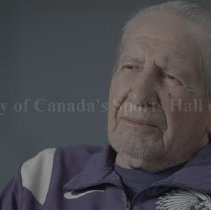
Oren Lyons Interview |
Scope & Content |
Oren Lyons, 18 October 2023, interview. Born digital MP4, viewing time 00:28:50. CBC Sports' Devin Heroux speaks with Oren Lyons, 2023 Order of Sport recipient. Transcript: Interviewer: First, let's start by offering you huge congratulations. Oren: I made the men's team when I was 15. That was 1945. I've been there ever since. My father was a goalkeeper. I was out front. I was playing attack at the time. We were playing in New York City. We were on Long Island. And it rained. So, our game got called off, actually, we thought. And our goalie went out and got drunk. And so, it cleared up. They said, "We're going to play." I said, "Well, we got a goalie over there…" So, they said, "Well, your father was a goalie. You get in there." And I've been in there ever since. That's how I got into goalkeeping. I played actively from 1945 to I'd say 1955, '60. Interviewer: You were sharing with me that it's so much more than a game. Oren: Yeah. Well, for us, you know, it was played on the other side of the stars while the Earth was still covered with water. And our creation story talks about that. And how we know that is that the woman who became known as Sky Woman, her leader told her to go and get some water. So, she was getting water. And he said, "Go get water and come right back." And on her way back, there was a lacrosse game going on. And one of the players said, "I need a drink of water." So, she stopped and gave him a drink of water. And when she got back, the leader said to her, "I told you to come straight through. You stopped and gave this player a drink of water. Go back and get water again and come straight back." And so that's what she did. So that's how we know that lacrosse was on the other side at the time. That's in our creation story. That's a long story. So how she gets from there and the others to here is a whole big story of how the turtle became a-that's where the turtle came from. And it's our cosmology. Very intense and very old and very long. Interviewer: When you were young, born, and coming into the game in sport, were you aware that it held this much significance? Oren: I had no awareness at all. You know, we just played. I just knew it was there all the time. I grew up. You know, my father was a goalkeeper. And I remember, you know, this was before electricity, a lamp light, and he was sitting there fixing his stick. And my brothers and I were watching him, how careful he was fixing his stick. He was a goalkeeper, and it was by lamp light. That's how far back. And the transition that I've seen, because I was born in 1930, so I saw a lot of the change. It was amazing, because it was horse and buggy days. You know, I knew how to harness a horse. I knew how to harness a-and here we are with flying past the moon. You know, all in a lifetime. Interviewer: I'm thinking about that. I'm thinking about watching your dad. Lace his stick all those years ago, and now here we are, preparing for your induction to the Canadian Sports Hall of Fame. What does that mean to you? Oren: Well, it was something I could never anticipate. I didn't have any idea that that would occur, you know, of course. But I couldn't wait to play, you know, because that was intrinsic to our community. Everybody played lacrosse. I mean, I watched the old timers. I watched their moves. You know, all those kids, you know, were just watching everything and watching amazing, amazing players and the whole structure of the game and making the stick and what it takes to make a stick, you know. We just lost our premier stick maker [Alfie Jacques], and his dad was, you know, my contemporary. I played lacrosse with his dad. His dad was an extraordinary person. And he taught his son to make-he made the sticks. He started to say, "Hey, we got to make the sticks." So, he just went out and he's, you know-we've been carving sticks for a long time. So, hickory, second growth hickory makes the best one. It's resilient. It bends well. And there's-when we play the game, the medicine game, then that's when the stick comes into full understanding. It's not just-I don't know-it's not just our game. Then it's explained that the wood represents all the trees of the world, that the cut that makes the net represents all the animals of the world, and that the combination and the netting represents the communities. So, it's not just a stick. So, we learned- I had to learn that you know. And you learn it over a period of time, you know, as you grow up and so forth. Everything is in its time. But when you're, you know, a little guy, all you did was you just want to play, you know. And probably one of the highlights of my life, really, literally, was I got to shake the hands of the great player, football player, out of Carlisle. I'm just trying to remember his name now. Interviewer: Jim Thorpe. Oren: I got to shake his hand. And there was a year that he passed on, actually. My great uncles, my family, Lyon's family, played with him in Carlisle. So every time he was managing a wrestler by the name of Sonny Warcloud, he was a Mohawk wrestler. And they make a circuit, and they would come through Syracuse. Every time he came to Syracuse, he'd come down to Onondaga, and my great uncles were with him, and we were practicing. Well, there he was, you know. It was my great uncle's standing watching us practice. So, I got a chance to shake his hand. Interviewer: You're going into the builder category. Oren: Yeah. Interviewer: Because you have built teams. You have built community. Tell me about watching a team come together, because you and I were talking about the individual mentality and the team mentality. Oren: Well, yeah. They're talking about community. You know, the game originally was played for medicine. That was its original purpose for the community. It was a medicine game, and it still is, and we still do it. You know, and everybody gets out there to play, and its old style. It's two stakes in the ground and that's your goal. And probably about eight feet apart. There were probably about ten feet high, the stakes are. And the idea, of course, is that the ball's through there, and there's any number who show up. Everybody plays. There was no referees. There was no officials. It was just a ball, the sticks, and the players. And a lot of rules. There's a lot of rules to it. Where everybody knows the rules, but the games are hard. You would think it would be easy to get a goal through those things. You can be there for three hours and not get a goal. That's how hard the game is. You know, when you got 80 men out in the field chasing that ball around, and you pick that ball up, you better move it pretty fast. And so, but it's fun. Everybody loves that game. People show up, you know, and then let's play for an individual. And prior to the game itself, it was a ceremony to that. A sacred ceremony. A fire is built, tobacco is burned. They talk for the person. All the sticks are laid down, and all wooden sticks. You better not show up to a medicine game with a plastic stick. We call that Tupperware. You can't show up with Tupperware at these games. You better have your wood stick. And they all do. All our players keep that stick for the game. Interviewer: When I hear you talk about the importance of this, I think about the lack of understanding Canadians might have. Oren: You know, there's something intrinsic about the game, though. That all the players, I don't care where you've been, there's a certain relevance and a certain understanding that there's an extra special step to this game. Everybody knows that. You know, there's a reference - a reverence - And when we play the international games, we have a speaker, we burn tobacco, we do the whole thing, and a big circle of all the players, and they really, really treasure those moments, you know. So this element of spirituality is in the game. There's no doubt about it. Interviewer: What did you learn through all of that? Because there's also an aspect of activism to this as well, from an initiator, as I understand, and speaking at the UN. Oren: Well, you know, the issue, you know, for the Haudenosaunee, now you're talking Haudenosaunee, was a great peacemaker. A great peacemaker brought us together so long ago. They're trying to pinpoint the time. And I've had my battles with anthropologists and, you know, trying to tell us our own history, you know. But anyway, the people in Cornell University, they're researching it back, and they think, and they're doing that because part of our cosmology is, as they're talking about the time that he was trying to bring the Seneca Nation into the Confederacy, he was building a peace. I'm talking about the peacemaker. And they were very difficult. They didn't want to know anything about that and so forth. Then he predicted, he said, "Well, tomorrow I'll cover the sun." And the next day there was an eclipse, and that convinced the Senecas to join the Confederacy. And so, they were going back there, and they were trying to find that eclipse, and they figured it as somewhere around, 1,600 years ago. They're zooming in on it now, the actual time. So, our Confederacy is very old, and we know that. And I've had my battles with anthropologists and archaeologists over this issue. You know, you're trying to tell me about my history, you know. But anyway, what I'm saying is, we've been here a long time. The Confederacy is based on peace. And if you see our symbol, you know, what we have a wampum belt that was made during that time, and the center is a tree of peace. So, there it is. I mean, you can't argue with that. There it is. And that tree of peace represents Onondaga, where I come from. And the east is the Mohawks, and next to the Mohawks are the Oneida. And the center is Onondaga, and then to the west of us the Cayuga, and to the west of them the Seneca. And around 1712, the Tuscarora Nation were coming home. So, we brought them in 1712, not that long ago. And we became the Six Nations. So, the French call us Iroquois. The English call us Six Nations, and we are the Haudenosaunee. And so, people get confused with all these names and so forth, you know. But there it is. And it's the involvement of history. We've been involved right from the beginning. And when the Dutch came up the river on a ship that was captained by Hudson, they named the whole river the Hudson. [laughs] Just because there's this guy coming up on a ship. But Western nations have a penchant for naming places after themselves. Indian nations never named a place for themselves. That's so extraneous. So, what is that? What is that? You come and you say, "My mountain, so becomes somebody's name." We always had the reality of it. But I think that style of thinking has brought us to this point now where we are today. You know, if you don't think community, if you don't think the broad picture, if you don't think peace, you're going to have what you have today. Which is very serious trouble. The world is in serious trouble right now. And I encourage everyone, including yourselves and everybody else, not to give up. It's a big fight. And what I say is that the history of human beings here, and I haven't been here for that long. And there's nothing to say that we should continue either, in spite of what we say about ourselves. You know, you're here, you're gone, you're gone. That's it. And we're pushing that right now. So, the issue of peace, world peace, is foundational to survival as a species. And that's where we are. And how do you bring that to the fore now? I think it's fortunate that I have a moment here with you to remind the people who may be listening out there that peace is life. Without it, there's nothing. And everybody should not give up in spite of what's going on today. We're in a serious balance now. We're at what you call a tipping point. And trying to maintain a peace, they're really not having to maintain a peace. They're just trying to stop a war. But you can't stop a war and keep your own warplanes and your own guns and so forth. You have to disarm totally. And that's the only way you're going to have world peace, is total disarmament. Back to that. And if people think that that's impossible, well, see you on the other side. That's up to you. You think that way? See you on the other side. You know, we're just, we're like, human beings are like fleas on a dog. You know, we're quibbling amongst ourselves when the dog's getting ready to shake. And when he shakes, it's over. And that's nature. Nature's the boss. Nature's the boss. There's always been the boss and always will be the boss. And if you don't understand that, you just suffer the consequence. Interviewer: That requires humility. Oren: Yep. Yep. So, I think it's important for these events that we're going to be where a game is being celebrated, where peace can be talked about, where friendship and community can be talked about in spite of what's going on. And I really appreciate, you know, Canada's effort to do that and to support that and to promote that. It's important. Canada has a reputation for peace, you know, around the whole world. It hasn't worked too well for the Indigenous people, but nevertheless, there it is. And peace is the issue today, period. And friendship, and when we play this game of lacrosse, Deyhontsigwa'ehs, we call it. That's the name in our language, Deyhontsigwa'ehs. That's the name in the Onondaga language. And it means "you bump hips." And they took the hip check out of the game. And to me, that was the most amazing thing, you know. But our name for the game is that they bump hips, and they took the hip check out of the game. It was a good check. You know, a pretty small guy could stop a big guy with that hip check. But anyway, be that as it may, the wooden stick has transformed into the plastic stick. But what I say is let's not lose the spirit. Let's not lose the spirit of the game. I mean, we're going little by little, but now is the time to remember that. And our stick makers are making sticks all over again. They're making a lot of sticks. And people are buying the sticks and hanging them on the wall. Time moves on such as this. So, I do appreciate the fact that I've been given this great honor. It's an amazing honor. It's humbling. It's very humbling. And at the same time, it's uplifting for me, you know, for the person that's it. And it's uplifting for the game itself. And so, the Haudenosaunee surely never call Dehoñtjihgwa'és a sport. For us, it's not a sport. It's a game, and it's part of our ceremonies, and it has a place in our ceremonies. It has its own place. And fundamentally foundational to our whole confederation. And we used to settle differences between nations with a game. Wouldn't that be good today? Wouldn't that be the way to do things? Settle it with a game. Winner take all, and nobody get mad, and walk away and say "Okay, that's the way it is". So, it is. So that's the thoughts that I would present. And my perspective has grown. At my age now, I've got time for reflection and time for assessment and learned something over a period of time. It's experience, there's no, you know experience has to be what it is. There's no substitute for experience. It's hard life lessons that you learn. And try to pass it on to your kids. Younger people, don't do this, don't do that. But everybody has to learn for themselves. And their old adage, "Don't touch a stove". What do you do? You go over and you see what's going to be hot. So, there we are. But nevertheless, I think that Canada's Sports Hall of Fame is really important. It's important for the world. The game is important for the world. I don't know what you would call him, but I look to him every now and then for some of his thoughts, because they were funny and they were extraordinary, but they had a bite to them. That's Yogi Berra. You guys know who Yogi Berra is? Interviewer: Absolutely. Oren: Catcher for the, -- He used to say some funny things, but they always had a twist to it. They always had something behind it. And he would say something like, "Well, when they come to the fork in the road, take it." He had a great perspective, and he had also insight. And the one that I use now, he said, "Well, it ain't over until it's over." So that's where we are. And it ain't over. So, we keep fighting. So, I would say we're in the 15-round championship fight. We're in the last round, and it's even. So, get your head down, get inside, keep slugging. That's what you do. Get inside, keep slugging. Get that shot to the roots. Interviewer: And punch above your weight. Thank you. Oren: You bet. Interviewer: Thank you, Oren. And congratulations. Oren: Thank you. |
Date |
2023/10/18 |
People |
Lyons, Oren |
Search Terms |
Builder Haudenosaunee Indigenous Lacrosse |